In many public institutions, a memo still travels as paper. It waits in a tray, moves when someone carries it to the next office, and its progress is known only to whoever last held the file. When a request stalls, nobody can say where it is, how long it has waited, or who needs to act.
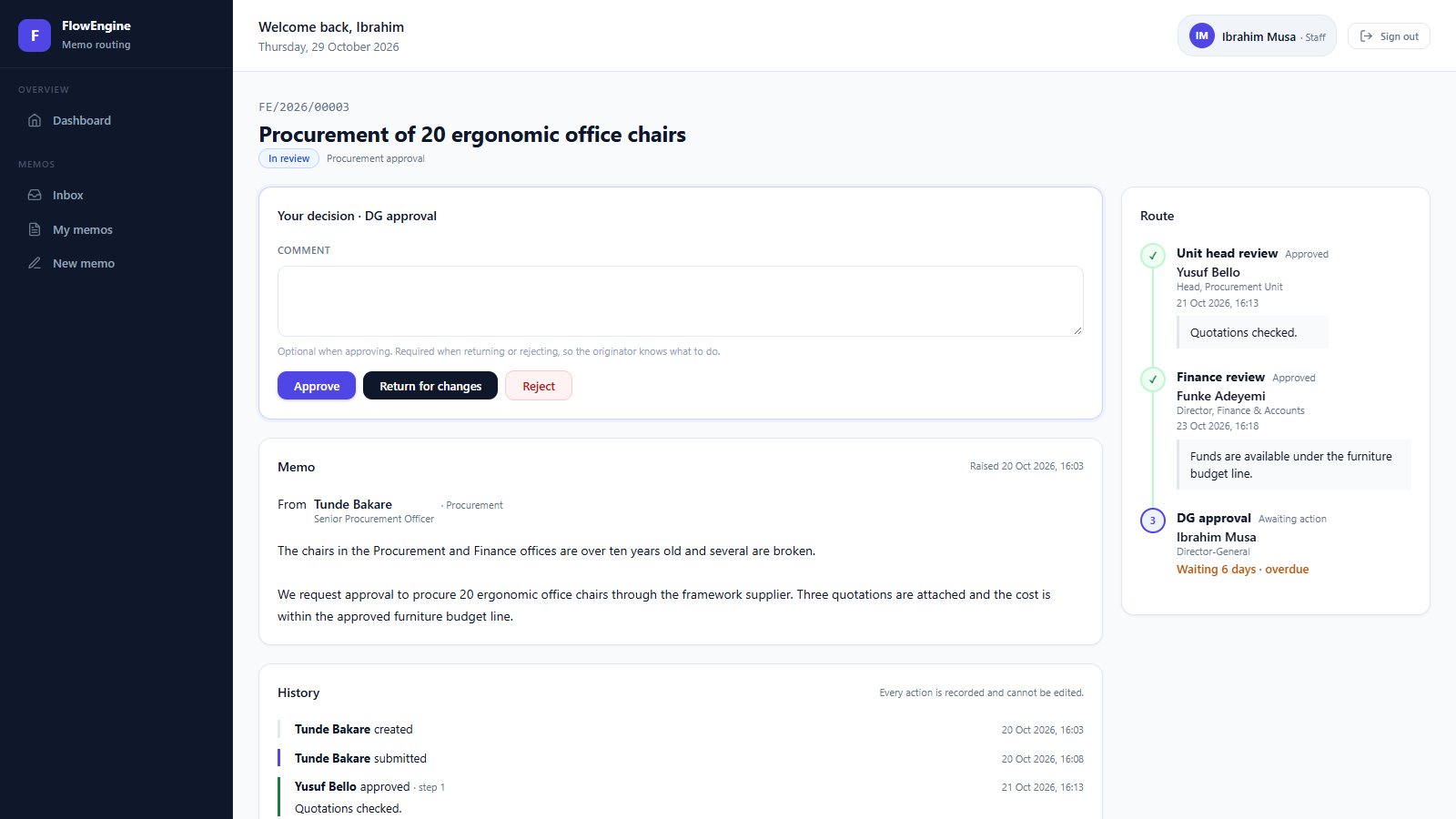
The Problem: Execution Lag in Paper Routing
- Invisible progress. Once a file leaves your desk, you can't see where it is or how long it has been waiting.
- Unrecorded decisions. Minutes written on a file can be lost, and there is no reliable record of who approved what, and when.
- Unclear responsibility. Without a defined route, memos go to the wrong office first, or skip a step entirely.
- No measure of delay. Management has no way to see which approvals are slow or where requests pile up.
How FlowEngine Works
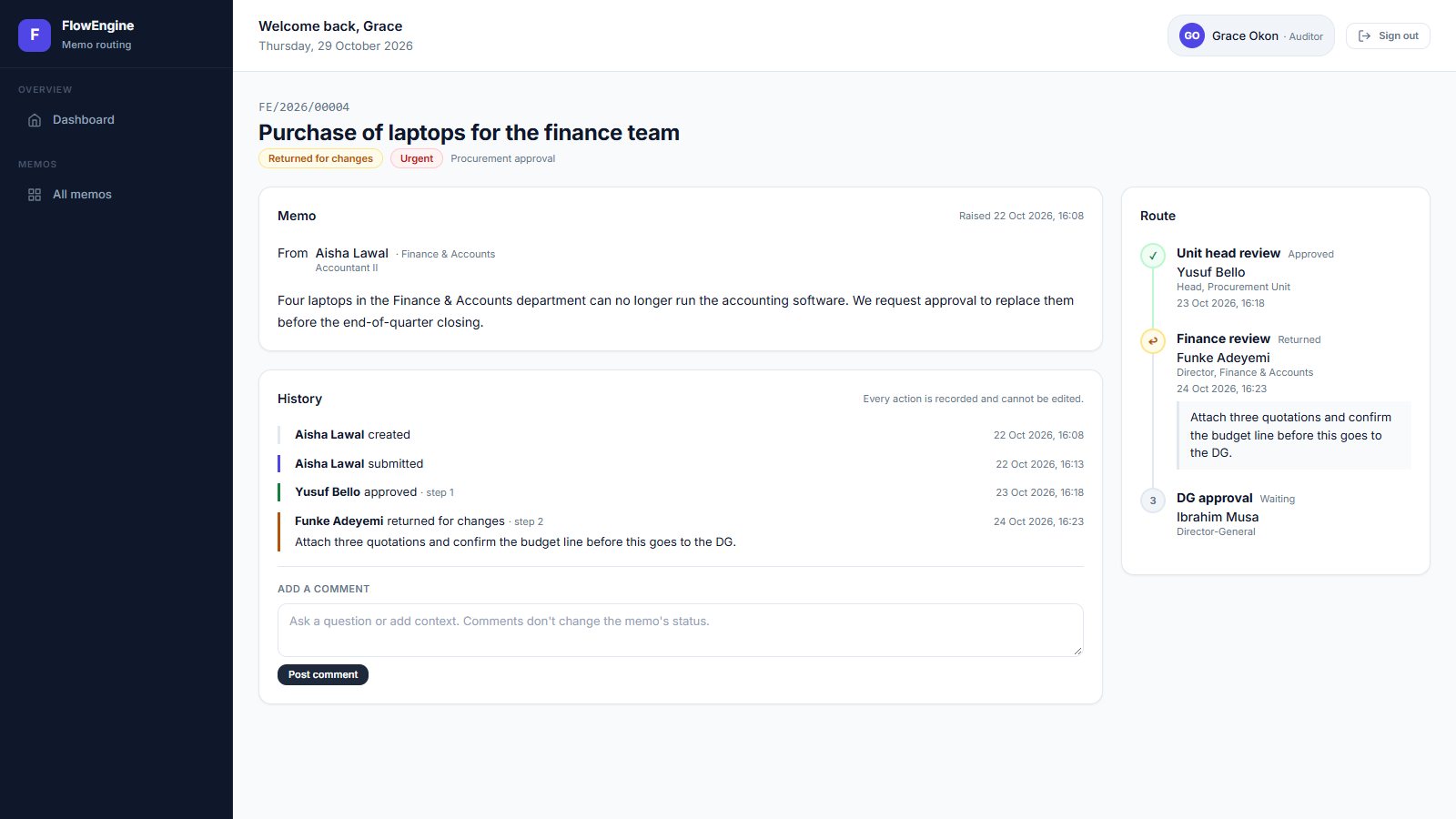
- Write. A staff member writes the memo and chooses its approval route, for example Unit Head, then Director of Finance, then the Director-General.
- Route. On submission the memo receives a reference and goes straight to the first approver's inbox.
- Decide. Each approver, in turn, approves it, returns it for changes with a reason, or rejects it.
- Record. Every action is written to the memo's history, with who acted, when, and what they said.
Every Approver Knows What Is Waiting
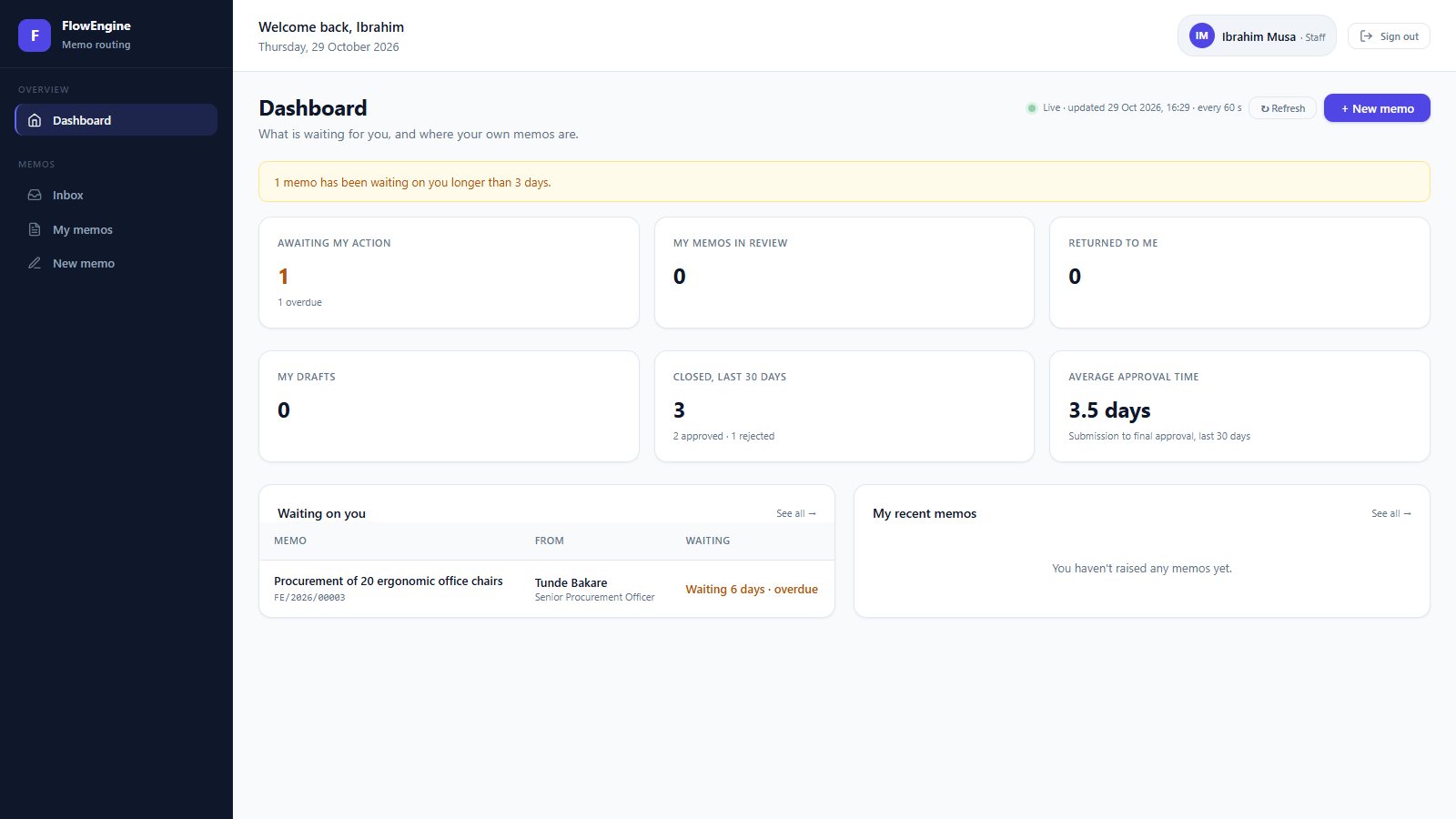
Each person's dashboard shows the memos waiting on them, oldest first. A step that has waited longer than the agreed time is flagged as overdue. That time limit is a setting the organisation chooses, not a fixed rule. Staff also see where their own memos are, and which have been returned to them.
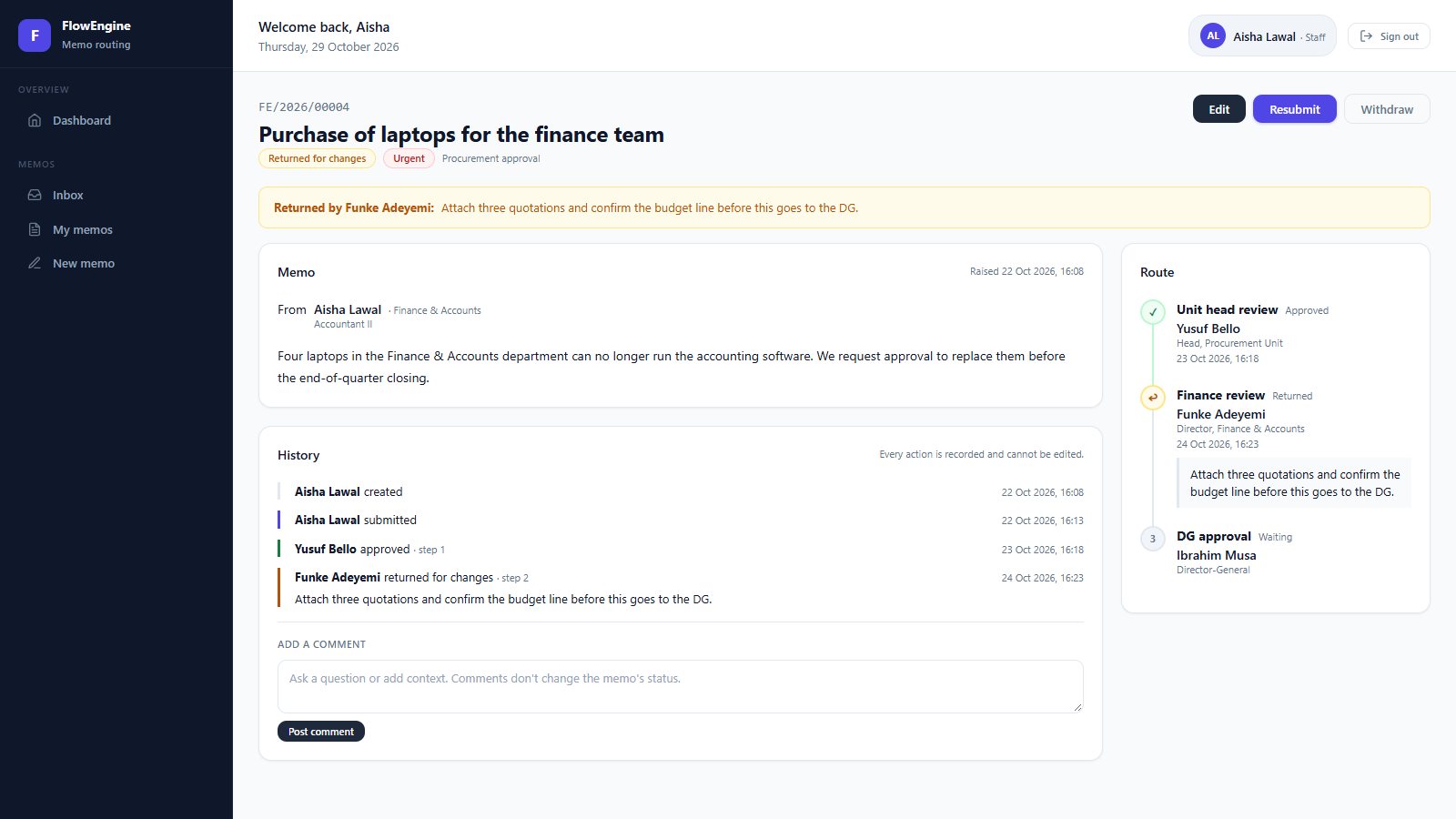
Returned, Fixed and Resubmitted
When an approver returns a memo, they must give a reason, so the originator knows exactly what to change. The originator edits the memo and resubmits it. Review starts again from the first step, the memo keeps its reference, and the return, the edit and the resubmission all stay in the history.
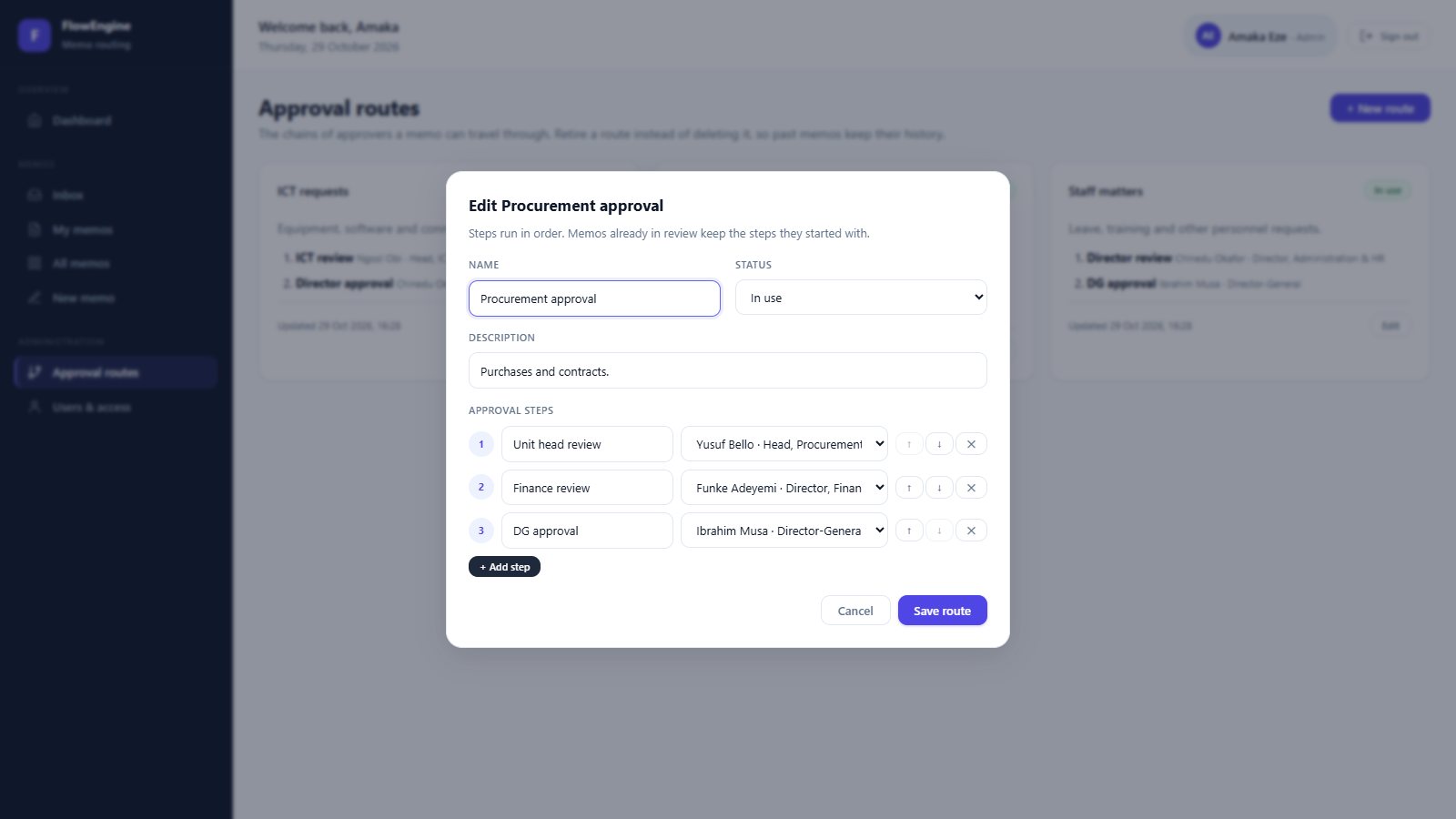
Routes Set Up by the Organisation
Administrators define the approval routes once, for example procurement, staff matters or ICT requests. When a memo is submitted, its route is copied onto it, so changing a route later never affects memos already on their way.
Safeguards Built In
- Separation of duties: nobody can send a memo through a route on which they are an approver, and each approver appears only once per route.
- Private drafts: a memo is visible only to its author until it is submitted.
- Need-to-know visibility: staff see their own memos and those routed through them; administrators and auditors see every submitted memo.
- Auditor access: auditors can read every memo and its history and add comments, but cannot approve, reject or change anything.
- A permanent record: memos and their history are never deleted, and the history cannot be edited.
Technology
FlowEngine is built with Django and Django REST Framework on PostgreSQL, with a React dashboard. Every change of state runs through a single, tested workflow layer, so the rules are the same however a memo is reached. Sign-in uses secure httpOnly cookies, and the system ships with Docker, Gunicorn and Nginx for deployment on a cloud server or on-premises.
Conclusion
FlowEngine removes the lag between a request and a decision. Memos follow a defined route, delays are visible as soon as they happen, and every decision is on record.
The same approach suits any institution where requests need a chain of approvals: ministries, agencies, universities and development programmes.
Interested in digital memo routing for your institution?
BravEdge sets up FlowEngine around your own departments, approval routes and reporting needs.
Collaborate With Us